
AI Will Not Save Your Career. Structure Might.

There is a quiet problem inside modern work. It is not that people are lazy. It is not that they lack talent. It is not even that they do not know how to use the tools. Many capable professionals are already working hard, solving difficult problems, managing complexity, protecting outcomes, and carrying real responsibility. The problem is that their communication often makes the work look smaller than it is.
This matters because organizations do not only evaluate work through outcomes. They evaluate work through the way those outcomes are explained, framed, escalated, summarized, and connected to decisions. A strong contribution can lose force if it arrives as a long update with no clear point. A real risk can be missed if it is buried under context. A smart recommendation can sound tentative if the message never makes the decision visible.
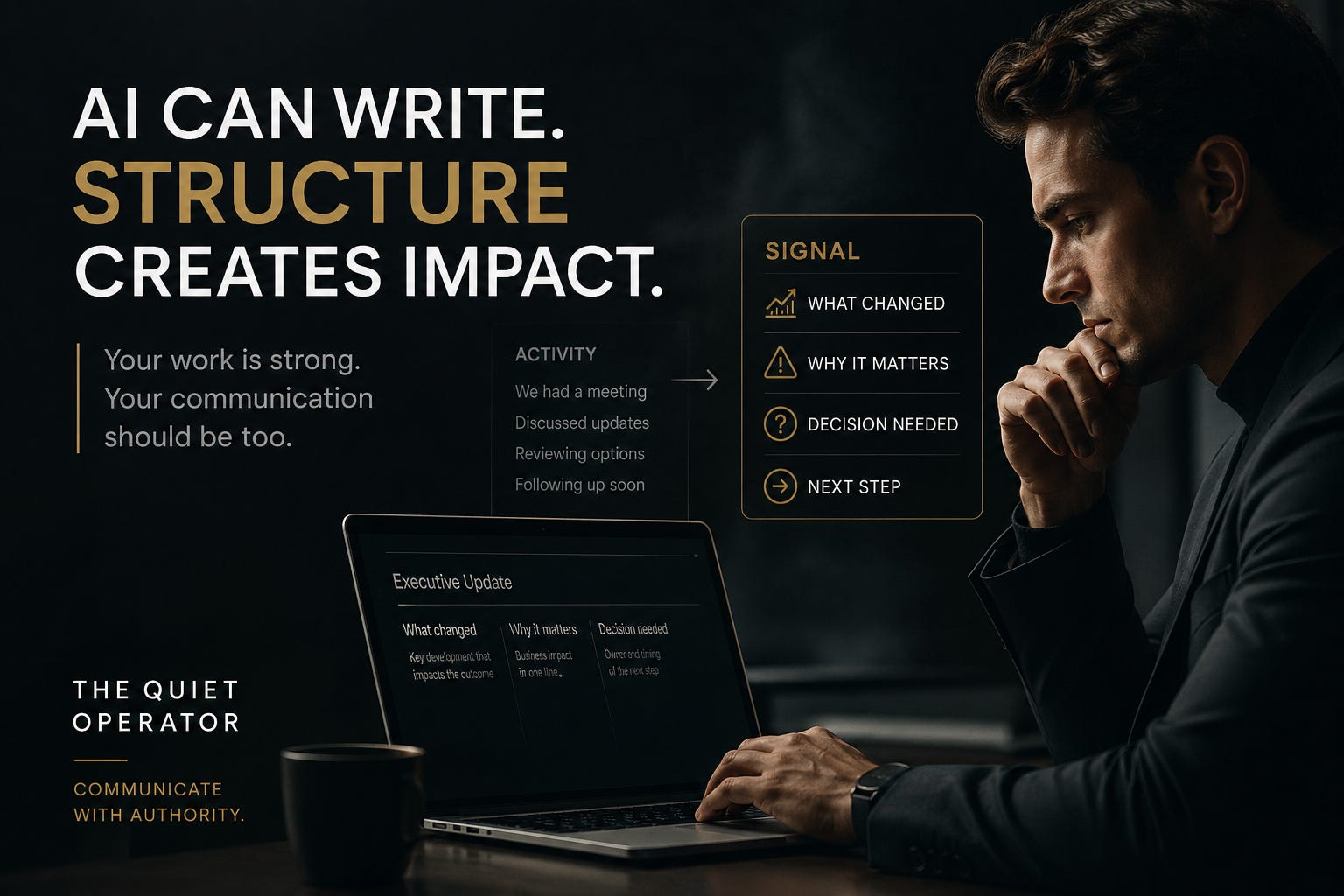
This is where many professionals lose leverage. They communicate activity when the audience needs signal. They explain what happened before explaining why it matters. They list meetings, follow-ups, reviews, and next steps, but leave the reader to infer the actual meaning. The update may be accurate. It may even be thorough. But accuracy and thoroughness are not the same as clarity.
Senior communication works differently. It does not simply answer, “What did I do?” It answers, “What changed, why does it matter, what decision is needed, and what happens next?” That shift is subtle, but powerful. It moves the message from reporting effort to creating judgment. It makes the reader’s job easier. It turns work into signal.
AI makes this problem more interesting. Used casually, AI can make weak communication sound more polished. It can smooth out awkward phrasing, soften tone, clean up grammar, and make a vague update look more professional. That feels useful, and sometimes it is. But polish is not structure. A polished message can still hide the point. A professional-sounding email can still fail to clarify the decision. A cleaner recap can still leave everyone unsure about ownership.
The professionals who benefit most from AI will not be the ones who generate the most words. They will be the ones who use AI to clarify thought. They will ask better questions before asking for better sentences. They will use the tool to surface the risk, compress the noise, identify the decision, and make their judgment visible.
That is why the idea behind The Quiet Operator is interesting. It does not treat AI as a shortcut for sounding more corporate. It treats AI as a way to build clearer professional structure. The premise is simple: your work may already be strong, but your communication may be the thing holding it back.
The site includes a two-minute assessment, a live rewrite tool, a free guide, and a full prompt system designed to help professionals turn updates, escalations, recaps, and self-reviews into communication that feels decision-ready. But the most valuable part is not the product format. It is the standard underneath it.
Stop reporting activity. Start creating signal.
That is a skill worth building, especially now. As AI makes average communication easier to produce, clear communication will become more valuable, not less. The future will be full of polished noise. The advantage will belong to people who can make things clear.
Start here:
thequietoperatorlab.com