
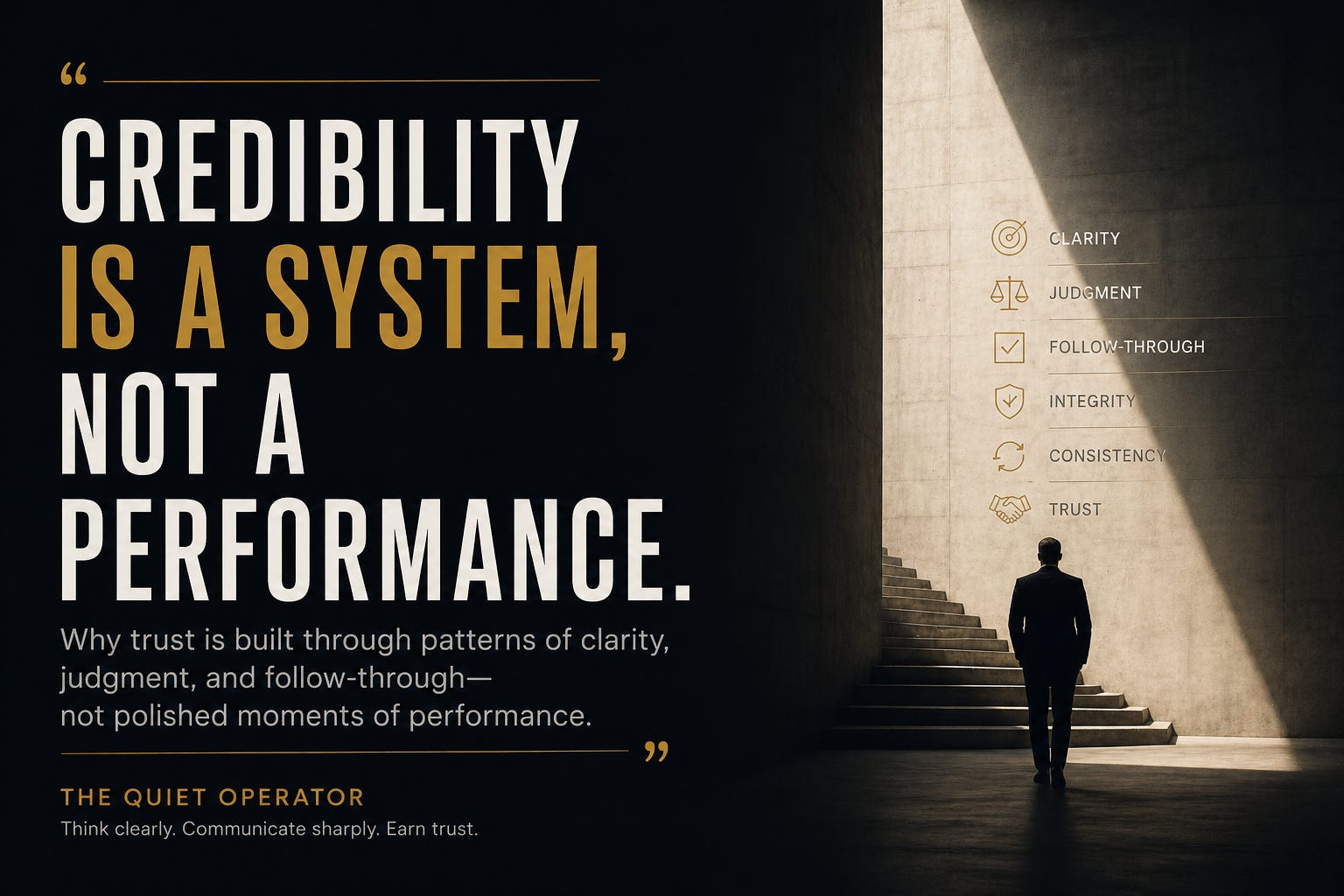
Credibility Is a System, Not a Performance
Why trust is built through patterns of clarity, judgment, and follow-through, not polished moments of performance.

Credibility is often treated as a matter of presentation. People try to sound more confident, speak with more polish, make cleaner slides, use sharper language, and appear more strategic in the moments where visibility is highest. There is nothing inherently wrong with that. Presentation matters. Tone matters. The way ideas are carried into a room can shape whether they are heard.
But presentation is not credibility. At best, it is an introduction to credibility. It can create interest, but it cannot sustain trust.
Credibility is not the impression you create once. It is the expectation you create repeatedly.
That distinction matters because most professionals overinvest in visible moments and underinvest in operating patterns. They prepare carefully for the senior meeting, the promotion conversation, the big presentation, or the high-stakes update. But credibility is rarely built only in those moments. It is built in the quieter rhythm of how someone communicates, follows through, escalates, clarifies, and handles uncertainty when the spotlight is not on.
A person becomes credible when others begin to associate them with reduced uncertainty. Not because they always have the answer, but because they can make the situation clearer. They separate what is known from what is assumed. They name risks before those risks become surprises. They communicate decisions instead of merely describing activity. They close loops. They tell the truth in a form other people can use.
There is a quiet relief people feel around someone credible. The room gets less foggy. The issue becomes easier to understand. The next step becomes harder to avoid. The person may not be the loudest voice or the most charismatic presence, but they make reality easier to see. That is a form of leadership, even when it does not look theatrical.
This is one reason credibility is so often confused with confidence. Confidence is visible. It has posture, speed, fluency, and force. It can be performed convincingly, especially in organizations that reward people who sound certain. Credibility is slower. It takes longer to recognize because it is not only about how someone speaks. It is about whether their words, judgment, and follow-through continue to match when the situation becomes difficult.
Confidence says, “I can handle this.”
Credibility says, “You have seen me handle things carefully enough that you do not need to guess.”
Confidence can open a door. Credibility is what lets you stay in the room.
The difference becomes obvious under pressure. Almost anyone can communicate well when the facts are clean, the audience is friendly, the timeline is relaxed, and the consequences are low. The real audit happens when the information is incomplete, the decision is uncomfortable, the owner is unclear, and everyone wants reassurance faster than reality can provide it. In those moments, the temptation is either to panic or to perform.
Panic exaggerates. Performance conceals. Credibility does neither.
A credible person can say: here is what we know, here is what we do not know, here is the likely impact, here is the decision needed, here is who owns the next step, and here is when we will know more. That kind of communication does not guarantee a perfect outcome. It does something more important. It preserves trust while the outcome is still uncertain.
That is one of the most underrated forms of professional value. Trust is easy when everything is working. Credibility is built when things are not working and people still believe you are telling them the truth in a usable form.
In that sense, credibility is a system. It is not one trait or one performance. It is a set of habits that compound over time. Your credibility system includes how you prepare, how you listen, how you frame issues, how you summarize decisions, how you escalate risks, how you admit uncertainty, how you close loops, and how you behave when reality changes.
Every interaction either strengthens that system or weakens it. Usually not dramatically. Usually quietly.
A vague update leaks credibility. A missed follow-up leaks credibility. An avoided escalation leaks credibility. A meeting recap with no decision leaks credibility. A polished message that hides the real issue leaks credibility. None of these moments may seem decisive on their own, but credibility rarely collapses all at once. It erodes through tolerated gaps between what people expect from you and what they repeatedly experience.
The opposite is also true. A clear update builds credibility. A thoughtful recommendation builds credibility. A calm escalation builds credibility. A closed loop builds credibility. A well-framed risk builds credibility. These actions may not feel impressive when they happen. They may feel almost too ordinary to matter. But that is how trust is usually built: not through the dramatic act, but through the repeated one.
This is why some people become trusted long before they become visibly powerful. They may not dominate meetings. They may not self-promote loudly. They may not have the most polished executive presence. But people begin to notice the pattern. When they send an update, the important part is usually clear. When they escalate, it is worth attention. When they say something is handled, it usually is. When they say there is a risk, the risk is real.
That is credibility compounding.
Over time, trusted people are invited into different conversations. They are brought in earlier, before the story is fully formed. They are asked for their read on ambiguous situations, not just for their output on defined tasks. They become part of the room where reality is being interpreted, not merely the workflow where work is being assigned.
That is one of the quietest signs of professional growth: people stop asking only what you can do and start asking what you think.
But that kind of access cannot be hacked. It can only be earned through consistency. A person can look credible for a moment, but they cannot fake a credible operating system for long. The pattern eventually reveals itself. The unanswered follow-up. The vague risk. The confident answer that collapses under scrutiny. The polished message that makes someone else do the real thinking.
Eventually, the system shows.
This matters even more in the age of AI. AI can make almost anyone sound more polished. It can smooth awkward phrasing, soften tone, clean up grammar, and produce language that feels professional. That is useful, but it also raises the standard. When polished communication becomes abundant, polish stops being a differentiator.
What remains rare is judgment.
The person who knows what matters. The person who can name the tradeoff. The person who can distinguish urgency from noise. The person who can communicate risk without drama. The person who can make an unclear situation easier to act on. The person whose words consistently make reality more usable.
That is the person people learn to trust.
The future will not belong to professionals who merely sound more fluent. It will belong to professionals whose communication reveals disciplined thinking underneath the fluency. The surface will be easier to manufacture. The structure will be harder to fake.
This is part of the philosophy behind The Quiet Operator. The point is not to become louder, slicker, or more performative. The point is to build the habits that make professional judgment visible without theater. Clear thinking. Structured communication. Calm escalation. Decision-ready updates. Respect for the reader’s time. The ability to turn complexity into signal without pretending complexity does not exist.
Those are not cosmetic skills. They are credibility skills.
And perhaps the most useful question is not, “How do I appear more credible?”
The better question is, “What system would make me easier to trust?”
That question changes the work. It moves the focus from image to operating discipline. From polish to pattern. From executive presence to executive usefulness.
Credibility is not a costume you put on before an important meeting. It is the residue of how you operate when the meeting is over. It is built in the small moments where you choose clarity over comfort, ownership over ambiguity, and truth over performance.
It is what people feel before they can explain why they trust you.
Say the thing clearly. Name the risk early. Close the loop. Keep the promise. Make the decision visible. Protect the standard. Reduce the burden. Repeat.
That is not glamorous.
That is why it works.
Credibility is a system.
Build the system.
——
Visit The Quiet Operator’s website at: thequietoperatorlab.com